Last Updated on September 6, 2026 by Irshad Quadri
A lipoprotein(a) test for heart disease risk could catch what a normal cholesterol test misses. Here’s why that matters.
You eat clean. You walk every day. Your last cholesterol test looked fine.
The 7-Day Cholesterol Reset
Our #1 protocol to lower LDL naturally without pills.
- Rapid Grocery "Swap-List"
- Zero-Cooking Meal Options
- Daily LDL Tracking Sheets
So why did your neighbor, who does everything right, still end up with a stent at 40?
That question has bothered cardiologists for years. In March 2026, they finally changed the rulebook to answer it. If you care about your heart, this update matters more than almost anything else in the cholesterol world right now.
Let’s break it down together, no medical jargon, no fear-mongering.
What Changed in the 2026 Cholesterol Guidelines
Every few years, the American College of Cardiology and American Heart Association update how doctors should manage cholesterol. In March 2026, they released a fresh version. It’s a big one.
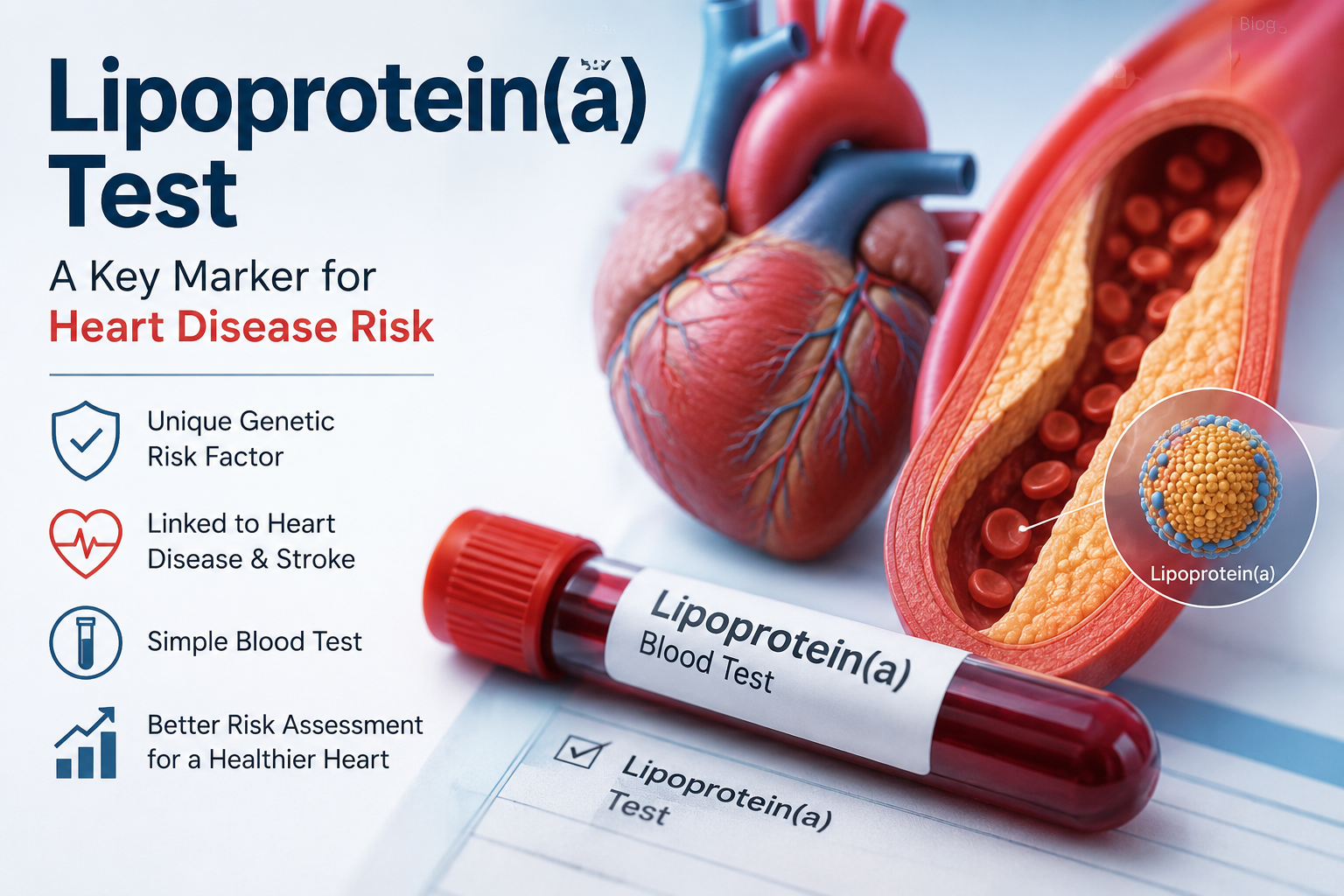
Three things changed. First, doctors retired an old risk calculator. It had been overestimating heart attack and stroke risk by 40 to 50 percent for years. Second, a lipoprotein(a) test for heart disease risk is now recommended for every adult, at least once in their life. Third, a newer marker called ApoB got a bigger seat at the table, especially for people with diabetes or high triglycerides.
Why does this matter to you? Because your regular cholesterol test, the one you’ve done for years, doesn’t catch everything. It measures LDL and HDL. It says nothing about Lp(a) unless you specifically ask. And it rarely includes ApoB at all.
That gap has quietly caused a lot of “surprise” heart attacks. People with textbook-normal LDL still ended up in the ER. This guideline update exists because doctors got tired of that pattern.
What Is Lipoprotein(a), Really?
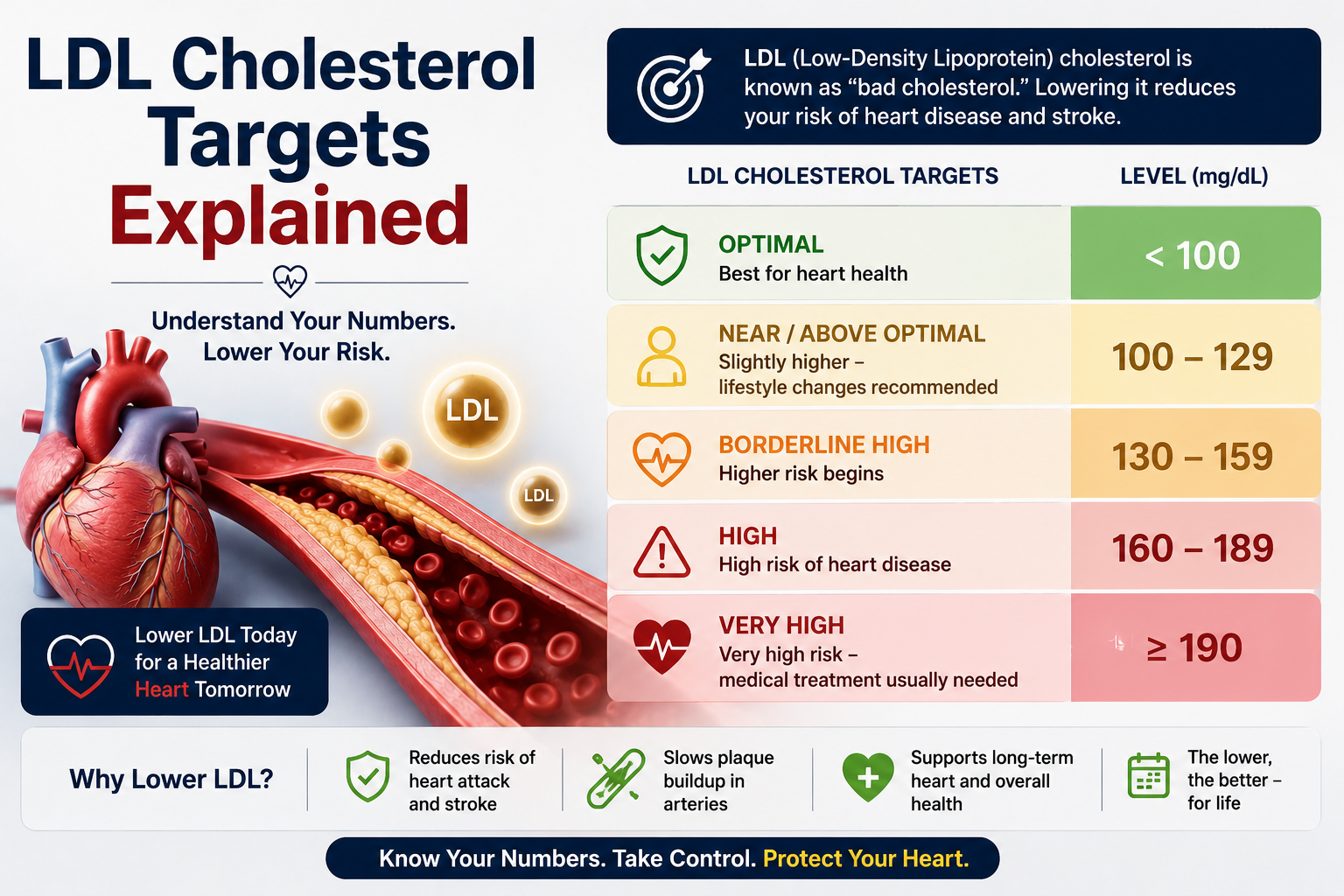
Think of Lp(a) as LDL’s more aggressive cousin. It’s a particle that carries cholesterol through your blood, just like LDL does. But it also has an extra protein attached that makes it stickier and more likely to cause plaque.
Here’s the part that surprises most people. Your Lp(a) level is almost entirely genetic. Diet, exercise, and weight loss barely touch it. You inherit it from your parents, and it stays fairly constant for your whole life.
About 1 in 5 people worldwide have a high Lp(a) level. Most never find out, because it doesn’t cause any symptoms on its own. The only way to know is a simple blood test, and most doctors won’t order it unless you ask.
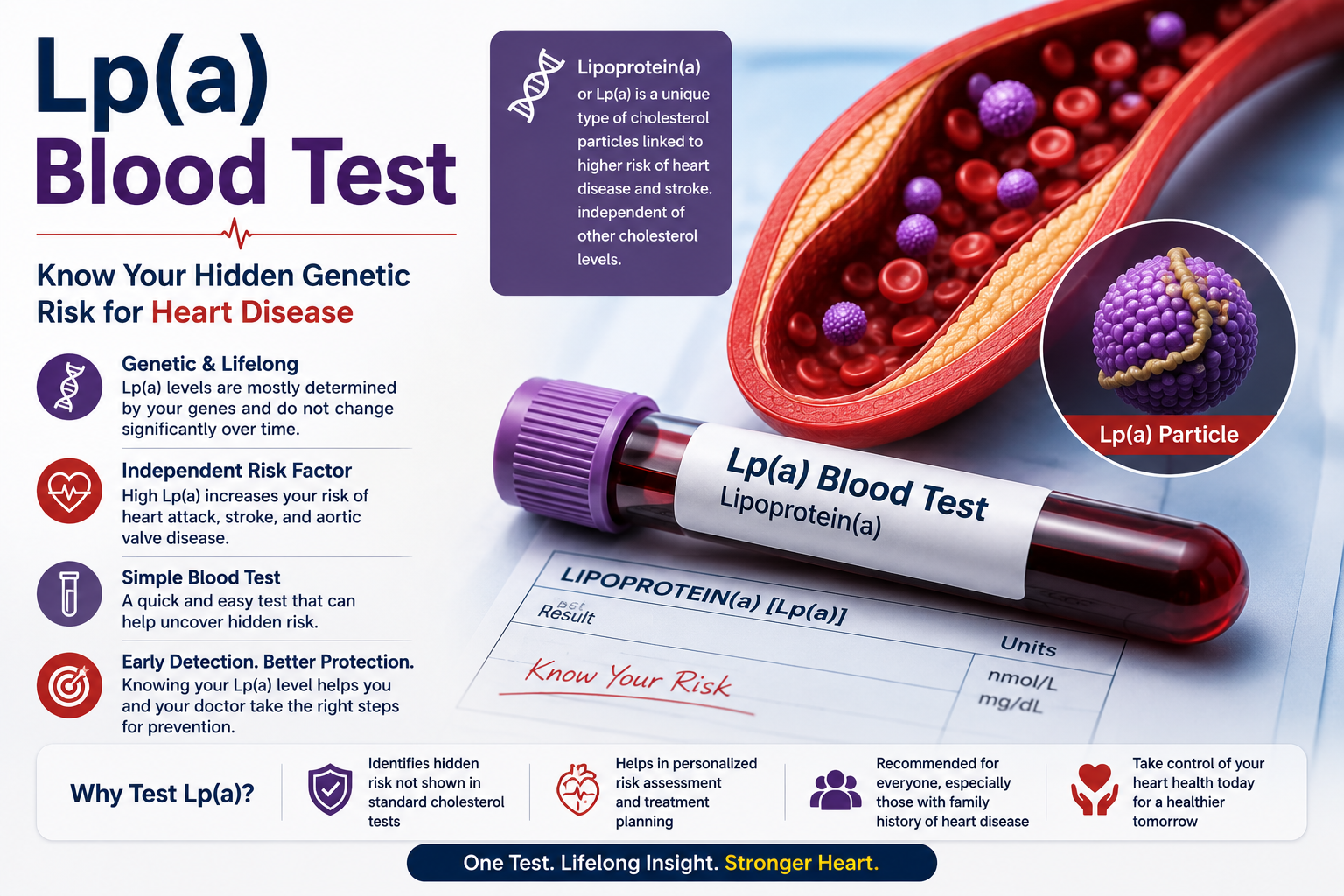
If your level comes back at 125 nmol/L or higher, your risk of heart attack and stroke goes up. Above 250 nmol/L, that risk can roughly double. Age and blood pressure still matter too, so this number alone doesn’t decide everything.
What Is ApoB, and Why It Matters Now
ApoB stands for apolipoprotein B. Instead of measuring how much cholesterol is packed inside your particles, it counts the actual number of particles.
Here’s why that distinction matters. Two people can have the same LDL number, but very different particle counts. More particles means more chances for plaque to form in your arteries, even if the total cholesterol content looks similar.
The new guidelines specifically call out ApoB for people with diabetes, high triglycerides, or LDL that seems oddly low. In these cases, standard LDL math can quietly underestimate real risk. ApoB gives your doctor a clearer, more honest number.
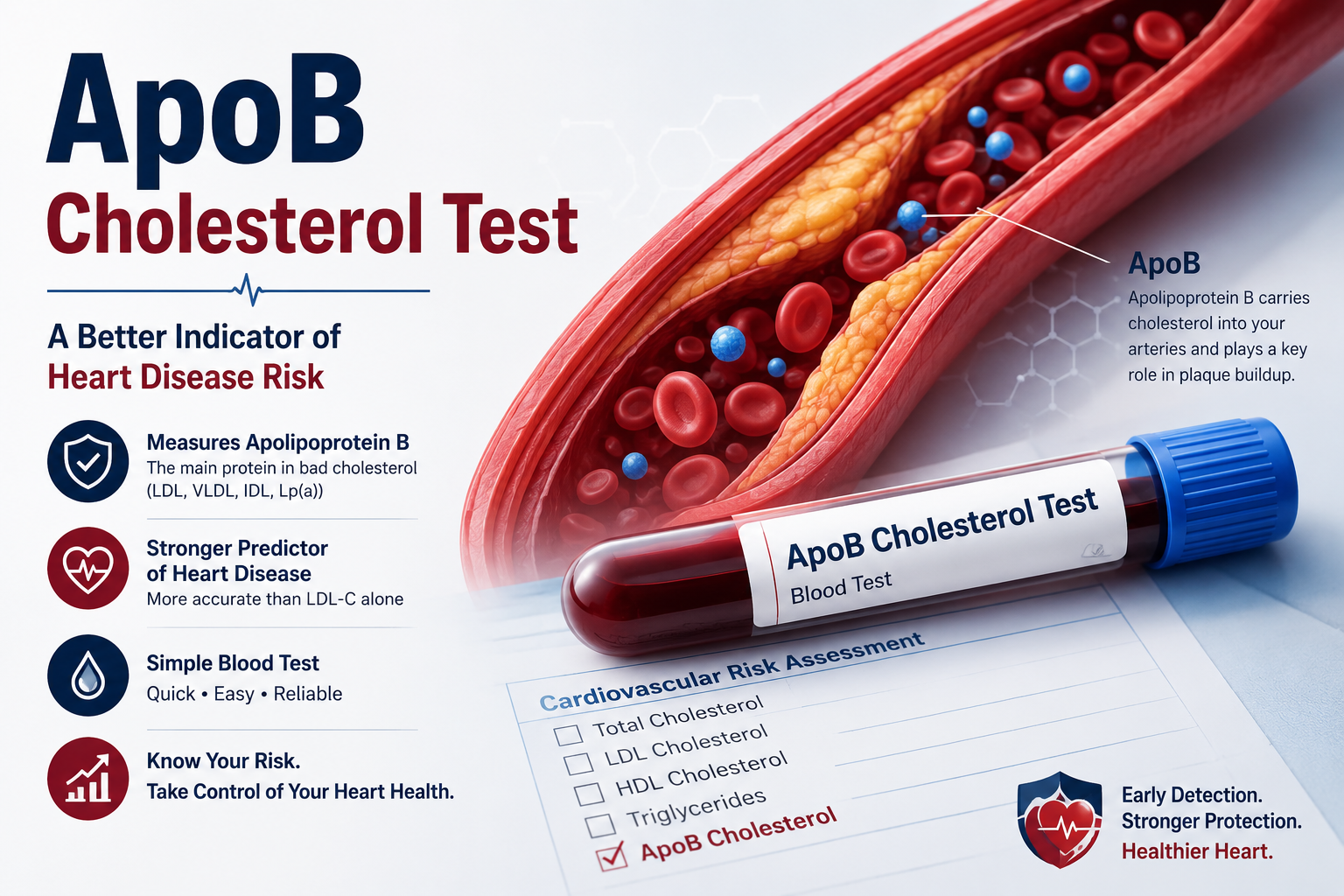
The good news? Unlike Lp(a), ApoB does respond to lifestyle changes and medication. Everything you’re already doing for your heart, from your 30-Day Cholesterol Reset to your daily walks, can genuinely move this number.
Your Complete Heart Risk Picture
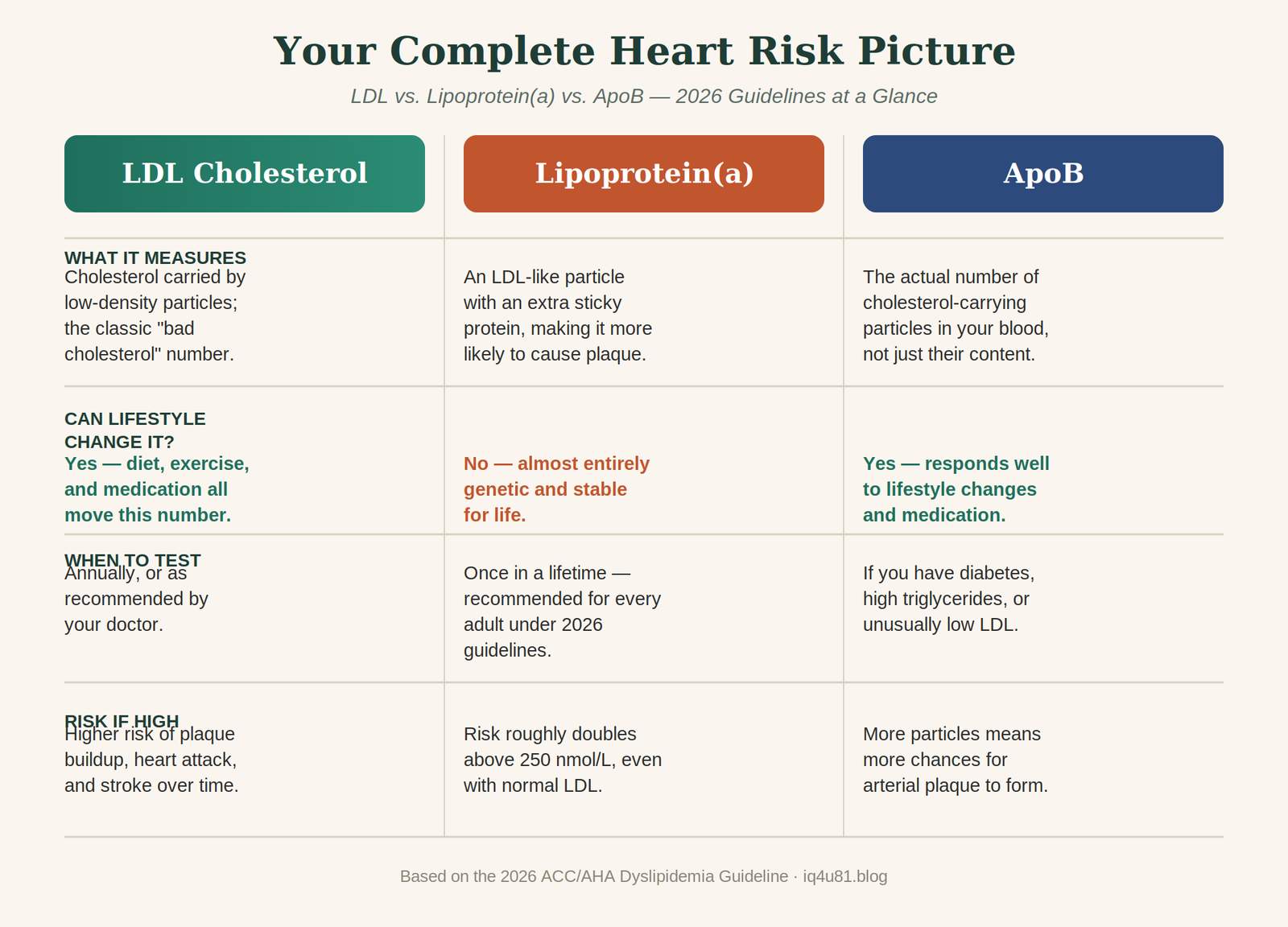
Use this as a quick reference when you’re talking to your doctor. It shows what each marker measures, whether lifestyle can change it, and when experts recommend testing.
Real Stories: When “Normal” Cholesterol Wasn’t the Whole Story
Numbers on a page can feel abstract. Real people make it real.
The 39-Year-Old With a “Perfect” LDL
A patient featured in a 2025 case study in Cardiology and Therapy had his first heart attack at 39. His LDL had always tested normal. A blood test later revealed an Lp(a) level of 330 nmol/L, more than double the risky threshold. He’d had two more coronary procedures since, all driven by a number no one had checked.
Read his full account, told alongside his own endocrinologist: published case study.
The 53-Year-Old With No Obvious Risk Factors
A medical case report describes a healthy, active, non-smoking 53-year-old woman with chest pain. Her total cholesterol and HDL were both normal. Her Lp(a) came back at 492 nmol/L, dangerously high, and she needed a stent.
The full case report walks through exactly how her care team caught it: read the case report.
Real Community Stories, Not Just Clinical Papers
The Family Heart Foundation runs an entire archive of first-person Lp(a) stories, written by patients and their families. One contributor describes rushing to the hospital despite being a healthcare worker herself. Another writes about discovering her risk only after a routine bloodwork surprise.
Browse these accounts: High Lp(a) Story archive. The American Heart Association shares similar accounts on its Lp(a) resource page.
None of these people were reckless with their health. That’s exactly the point of the new guidelines.
Who Should Actually Ask for These Tests
You don’t need to run to your doctor tomorrow in a panic. But a few situations make testing genuinely worth prioritizing.
- You have a family history of heart attack or stroke before age 55 (men) or 65 (women)
- Your LDL has stayed stubbornly high despite diet changes and medication
- You’ve been diagnosed with, or suspect, familial hypercholesterolemia
- You have diabetes, high triglycerides, or metabolic syndrome
- You simply want a once-in-a-lifetime baseline, since Lp(a) rarely needs repeat testing
If any of these sound like you, mention it at your next checkup. It’s one extra line on a lab order, nothing dramatic.
If Your Numbers Come Back High, What Now?
First, take a breath. A high number is information, not a diagnosis of doom.
If your Lp(a) is high, lifestyle won’t lower it much, but it changes your overall strategy. Your doctor may push LDL and blood pressure targets lower to compensate. Newer medications, including one called pelacarsen, are also in late-stage trials specifically for Lp(a).
If your ApoB is high, you have real levers to pull. This is where your existing habits matter most. Your stress management routine genuinely helps here. So does swapping in soluble fiber, which is exactly why so many people ask whether psyllium husk can help reduce cholesterol. It can, and it directly supports ApoB improvement too.
How This Fits Into What You’re Already Doing
Here’s the reassuring part. Nothing about this guideline update throws out your existing routine.
If you’ve been following a heart-healthy pattern, like the one in our 7-day natural cholesterol plan, you’re already working on the piece you can control. Garlic, often discussed in our home remedies for high cholesterol guide, has mixed clinical evidence for LDL specifically, so we won’t oversell it here. But the overall dietary pattern still supports healthier ApoB numbers.
If you’re a woman watching for early warning signs, our piece on early signs of high cholesterol in women pairs well with this update. Hormonal shifts affect your lipid panel, but they don’t touch your inherited Lp(a) level at all.
Think of Lp(a) and ApoB testing as adding two more data points to a picture you’re already building.
Common Myths About Lp(a) and ApoB
“If my LDL is normal, I don’t need these tests.” Both case studies above prove otherwise. Normal LDL doesn’t rule out high Lp(a) or ApoB.
“I can lower Lp(a) with diet, like I do with LDL.” Unfortunately, no. Lp(a) is genetically fixed. Diet mainly helps the other risk factors around it.
“This is only for people who already have heart disease.” The guidelines recommend universal testing, meaning everyone, healthy or not, at least once.
“If it’s genetic, there’s nothing I can do.” Not true. Knowing your number changes your entire prevention strategy, even if it can’t change the number itself.
“One test isn’t enough to be reliable.” Because Lp(a) stays stable for life, one accurate test really is enough for this particular marker.
Your Simple Action Plan
- Ask your doctor for an Lp(a) test at your next visit, even if you feel fine
- Ask about ApoB testing if you have diabetes, high triglycerides, or stubborn LDL
- If you have a family history of early heart disease, mention it clearly
- If your Lp(a) comes back high, ask family members to get tested too
- Keep working your existing heart-healthy habits, since ApoB responds to them
- Recheck your full lipid panel yearly, but remember Lp(a) rarely needs repeating
- Use a tool like our free Cholesterol Risk Checker to track your overall picture over time
Frequently Asked Questions
1. What is a lipoprotein(a) test for heart disease risk?
It’s a simple blood test measuring Lp(a), a genetic cholesterol particle linked to heart attack and stroke risk.
2. Is Lp(a) the same as LDL cholesterol?
No. LDL is affected by diet and lifestyle. Lp(a) is almost entirely inherited and stays stable for life.
3. What is considered a high Lp(a) level?
Generally, 125 nmol/L (50 mg/dL) or higher is considered high, with risk roughly doubling above 250 nmol/L.
4. Can I lower my Lp(a) with diet or exercise?
Not significantly. Lp(a) is genetically determined, so lifestyle changes have very limited effect on this specific marker.
5. What is an ApoB test, and how is it different from LDL?
ApoB counts the actual number of cholesterol-carrying particles in your blood, rather than just their cholesterol content.
6. Why did the 2026 guidelines add these two tests?
Because normal LDL alone missed real risk in many patients, as both case studies in this article show.
7. Do I need both tests, or just one?
Most adults benefit from a one-time Lp(a) test. ApoB is more specifically recommended for diabetes or high triglycerides.
8. Is Lp(a) testing covered by insurance?
Coverage varies by country and provider. Ask your doctor or insurer directly, since policies are changing quickly.
9. How often should I repeat an Lp(a) test?
Since it’s genetically fixed, one accurate test is typically enough for your entire lifetime.
10. Can statins lower Lp(a)?
Statins have little to no effect on Lp(a), though they still help manage your overall cardiovascular risk.
11. Are there medications specifically for high Lp(a)?
Yes, newer treatments like pelacarsen are in late-stage clinical trials and may be available within a few years.
12. Should my children be tested for Lp(a)?
If you have a family history of early heart disease, ask a pediatric cardiologist about screening.
13. What does “familial hypercholesterolemia” have to do with this?
It’s an inherited condition causing very high LDL from birth, often linked with elevated Lp(a) too.
14. Can high Lp(a) cause symptoms I’d notice?
Usually not. That’s exactly why routine testing matters, since it’s often silent until a cardiac event happens.
15. Does a gluten-free diet affect Lp(a) or ApoB?
Not directly. But the fiber-rich, whole-food pattern behind good gluten-free eating still supports healthier ApoB numbers.
16. What’s the difference between calculated LDL and ApoB?
Calculated LDL is estimated from a formula. ApoB is a direct particle count, which can be more accurate for some people.
17. If my Lp(a) is high, should my siblings get tested too?
Yes. Since it’s inherited, first-degree relatives have a meaningful chance of sharing your elevated level.
18. Can pregnancy temporarily change my Lp(a) level?
Levels can shift slightly during pregnancy, so most experts suggest testing outside that window when possible.
19. Is a high Lp(a) a guaranteed sign I’ll have a heart attack?
No. It’s one risk factor among several, including age, blood pressure, and overall lifestyle.
20. Where should I start if I want to track my full risk picture?
Start with your doctor for lab tests, and use a home tool like our Cholesterol Risk Checker to monitor your progress between visits.
Your cholesterol story is bigger than one number on an old-style test. The 2026 guidelines finally caught up to what many patients already learned the hard way.
Ask the question at your next appointment. It costs you nothing but a few extra minutes, and it might be the most important conversation you have with your doctor this year.

About the Author
Mission: Making a positive health impact on 10 million families worldwide.
Irshad Quadri helps everyday Americans take control of their cholesterol and heart health — naturally, without giving up the foods they love. At iq4u81.blog, he shares science-backed diet tips, easy cholesterol-friendly meal ideas, and practical guides trusted by readers across the USA. He is also a published Amazon Author on cholesterol health.
▶ YouTube | 📌 Pinterest | Facebook | ✉ Email | 🌳 All Links